Early childhood is one of the most influential stages of life, where the environment, guidance, and experiences impact a child’s personality. A Montessori preschool provides children with a nurturing atmosphere where curiosity and creativity are taught.
Unlike traditional classrooms that focus on teacher-led instruction, the Montessori approach values exploration, independence, and hands-on learning. These years are important, and the methods applied in preschool set a base for a child’s academic and personal growth.
Read on to learn more about the importance of Montessori preschool.
Building Independence & Confidence
One of the most significant advantages of a Montessori preschool is the way it encourages children to develop independence at an early age. From the moment a child enters a Montessori classroom, they are introduced to an environment designed for self-reliance.
Shelves are low so that children can access materials themselves. Activities are structured in a way that allows them to complete tasks without much guidance. This level of independence gives children a sense of accomplishment.
Encouraging Curiosity
Children are naturally curious, and a Montessori setting nurtures that curiosity rather than suppressing it. Instead of forcing all children to learn the same thing at the same pace, Montessori educators allow students to explore topics that interest them. This freedom turns learning into a joyful discovery.
For example, if a child shows an interest in plants, teachers may provide opportunities to water plants, observe their growth, or even learn the basics of photosynthesis in age-appropriate ways.
In traditional systems, children associate schoolwork with pressure, memorization, or grades. Montessori classrooms shift that mindset. Here, education is about exploration, not competition. The focus is not on test scores but on discovery.
Developing Social & Emotional Growth
Montessori classrooms are unique in the way they encourage social and emotional development. Rather than separating children strictly by age, Montessori schools group children of mixed ages together.
Younger children learn by observing older ones, while older children strengthen their knowledge by guiding younger peers. This creates a natural cycle of mentorship and cooperation.
The social environment is designed to promote respect. Children learn to wait their turn, share resources, and work collaboratively on projects. Instead of competing against each other, they are encouraged to support one another.
Fostering Critical Thinking
Critical thinking is one of the most valuable skills a person can have. Montessori preschools emphasize problem-solving from the very beginning. Children are not simply given answers; instead, they are guided to find solutions through exploration.
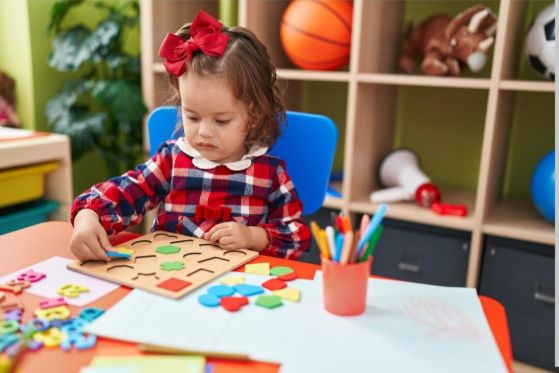
For instance, if a child is presented with a puzzle, the teacher does not rush to solve it for them. Instead, the child is encouraged to test different strategies until they succeed. This method strengthens persistence and logical reasoning.
Creating a Strong Foundation
A Montessori education gives children more than just early learning experiences; it builds a strong foundation for all future schooling. By the time children graduate from preschool, they have already mastered skills in independence, social interaction, and more.
Academically, Montessori children often excel in studies because they have learned through hands-on experiences. Beyond academics, children also learn how to manage their time and stay focused on tasks.

